

Climate adaptation
Heatwaves, heavy rainfall, hail and periods of drought are putting buildings and industrial sites under increasing pressure. Not only are these types of weather conditions occurring more frequently, but they are also becoming more intense and prolonged. By investing strategically in climate adaptation, you can protect existing and future assets, minimise the impact of extreme weather on comfort and productivity, and strengthen the continuity of critical operations.Climate adaptation
Heatwaves, heavy rainfall, hail and periods of drought are putting buildings and industrial sites under increasing pressure. Not only are these types of weather conditions occurring more frequently, but they are also becoming more intense and prolonged. By investing strategically in climate adaptation, you can protect existing and future assets, minimise the impact of extreme weather on comfort and productivity, and strengthen the continuity of critical operations.

A key component of your energy transition
For organisations, the energy transition means reducing CO₂ emissions, managing energy costs and strengthening their competitive edge. At the same time, we are facing a climate in which heatwaves, droughts, wildfires and flooding are increasingly causing system failures, operational disruptions, comfort issues and loss of productivity. For organisations with critical processes or services, this directly jeopardises the continuity of their operations.
That is why climate adaptation is an essential part of your energy transition. Only by combining decarbonisation and climate adaptation can you ensure the continuity, performance and resilience of your operations in a changing climate. CO₂ reduction minimises the impact of your operations on the climate. Climate adaptation limits the impact of climate change on your organisation.
Climate impact is already a reality today
Climate change is no longer a future scenario. Our recent research into decarbonisation and adaptation among industrial companies in Europe and North America shows that 48 % of Belgian industrial companies have already faced disruptions caused by climatic conditions in recent years. Yet today, only 30 to 40 % are taking concrete measures to adapt to climate change. At the same time, 93 to 97 % of organisations recognise its importance. The question is therefore no longer whether climate change will impact your organisation, but how well prepared you are for it.

What are the biggest challenges today?
For buildings
Many buildings were designed for climatic conditions that no longer reflect the reality of today and tomorrow. From hospitals and care homes to offices and public buildings: heat, flooding and rising cooling requirements are putting pressure on comfort, safety and service provision.
For industry
Industrial sites are designed for stable operating conditions, but today they are increasingly faced with extreme heat, water stress and pressure on critical cooling, process and energy systems. This puts production capacity, product quality, safety and business continuity under strain, whilst increasing the risk of unplanned downtime and operational losses.

The Equans approach
- UNDERSTAND
We gather data and insights, analyse them, and create a plan. With decisions we fully support as your implementation partner. - ACT
We install and manage concrete technical solutions, with a focus on continuity, safety, and feasibility. - ACCELERATE
Our solutions are future-proof and scalable, designed for long-term impact. We stay involved through optimisation and monitoring.
Why Equans?
Climate adaptation requires more than just a technical solution. It requires an understanding of what absolutely must continue to function, which risks have the greatest impact, and which measures make a difference today. Equans combines multidisciplinary expertise with hands-on operational experience to help organisations translate risks into concrete actions, ranging from strategic roadmaps to rapid and targeted interventions.
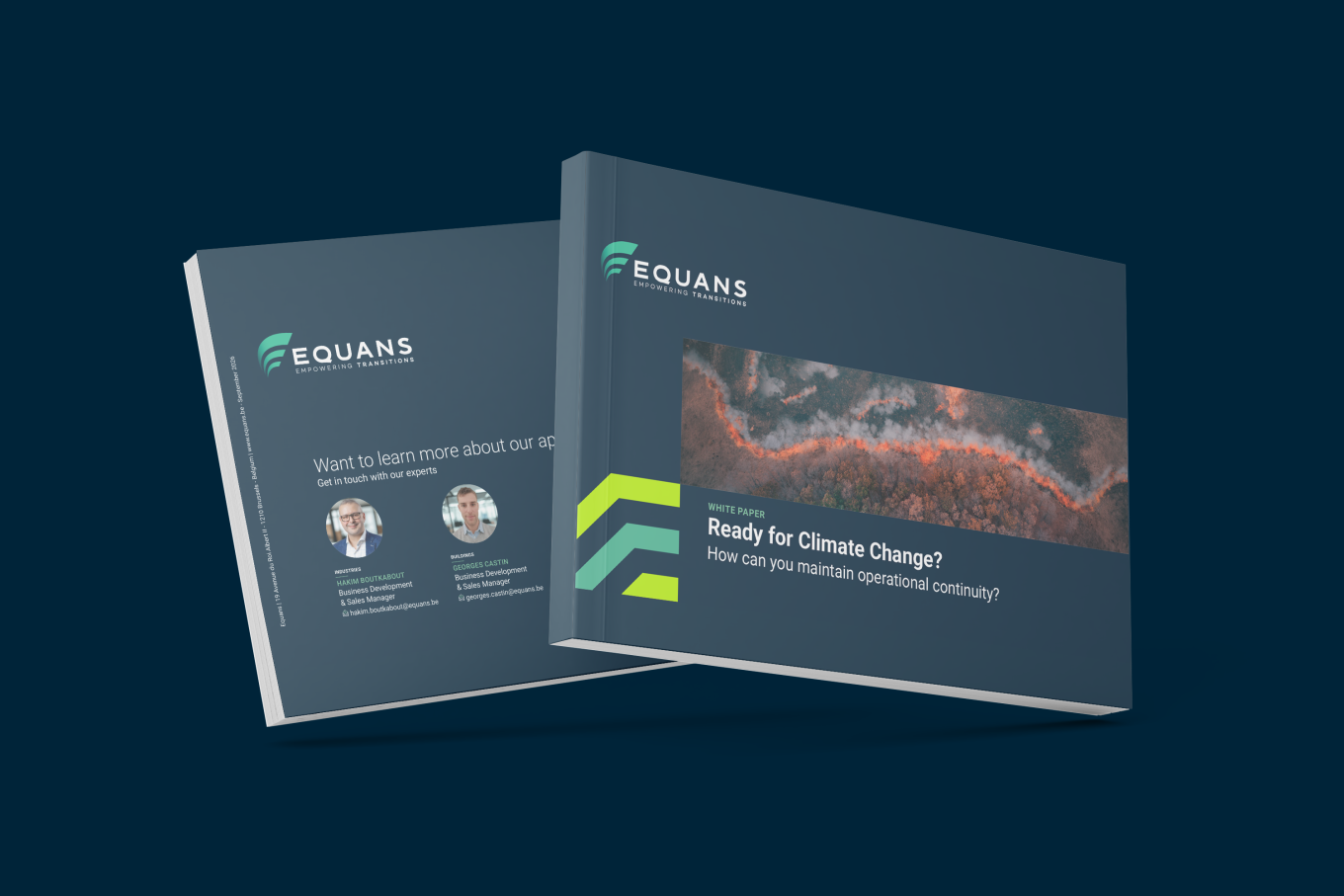
Download our white paper
Want to know more about climate adapation?
Frequently asked questions about climate adaptation
Climate adaptation involves adapting buildings, infrastructure and activities to the effects of climate change, such as extreme heat, drought, flooding and heavy rainfall. The aim is to minimise the impact of these events and to ensure the continuity of activities and services.
Extreme weather conditions are becoming increasingly frequent and intense. As a result, their impact on buildings, technical installations, infrastructure and operational processes is also growing. Organisations are facing new risks that could affect their services, operations and investment decisions.
Decarbonisation focuses on reducing the impact of activities on the climate by limiting greenhouse gas emissions. Climate adaptation focuses on limiting the impact of climate change on buildings, infrastructure and activities.
CO₂ reduction minimises your organisation’s impact on the climate. Climate adaptation minimises the impact of climate change on your organisation. Both are complementary and, together, form a forward-looking energy transition strategy.
Possible consequences include, amongst others, overheating of buildings, flooding, water shortages, failure of technical systems, loss of capacity, disruption to logistics processes and higher operational costs. The more interdependent systems are, the greater the potential impact.
Organisations with critical infrastructure, continuous service provision or sensitive technical installations are often the hardest hit. These include industrial sites, hospitals, healthcare facilities, public infrastructure, transport networks, data centres and large building complexes. For these organisations, heat, drought or flooding can have a direct impact on their operations and service provision.
A first step is to identify critical activities, dependencies and vulnerabilities. By gaining an understanding of the potential impact of extreme weather conditions, organisations can set priorities and target investments where the impact on business continuity is greatest.
Equans supports organisations in identifying climate risks, setting priorities and implementing solutions that help to build resilience. In doing so, we focus on buildings, energy supply, HVAC and cooling systems, water management, monitoring, digitalisation and operational continuity. Many of these solutions are already being incorporated into projects for buildings, infrastructure and industrial sites.
Depending on the situation, measures may relate to heat protection, HVAC and cooling, water management, redundancy of critical systems, energy security, monitoring or modifications to existing infrastructure. The appropriate approach varies depending on the organisation, building or site, and is always based on the specific risks and operational requirements.
Contact
Looking for a partner to guide your transitions?

Hakim Boutkabout
(Industry)
Business Development
& Sales Manager

Georges Castin
(Buildings)
Business Development
& Sales Manager