
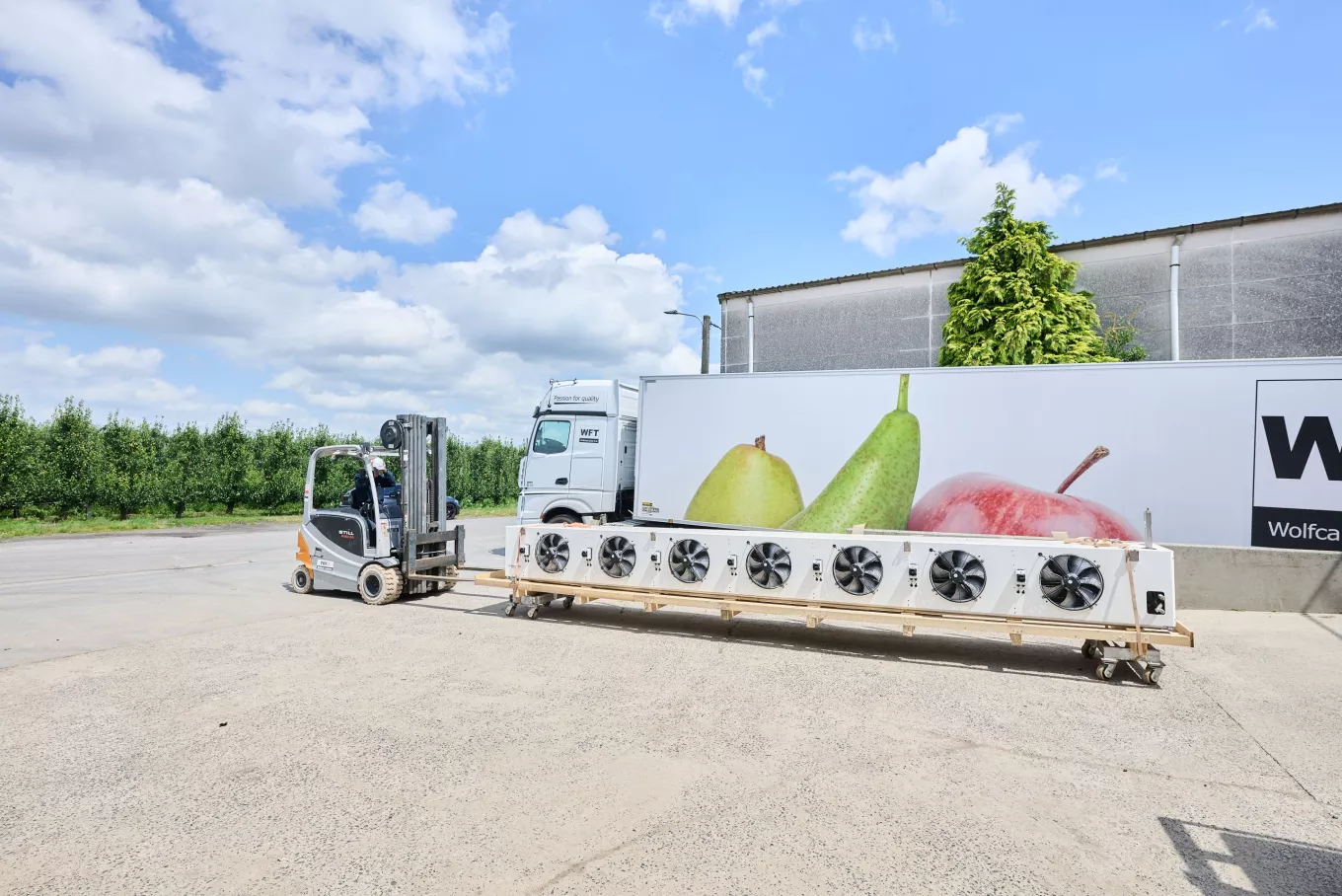
WFT Wolfcarius: sustainable industrial cooling
WFT Wolfcarius: sustainable industrial cooling
Energy-efficient cooling as a lever for lower costs and CO₂ reduction
For energy-intensive companies, cooling is a critical factor in both product quality and cost structure. At WFT Wolfcarius, a fast-growing family-owned company in the fruit sector, this reality led to a strategic decision: investing in a sustainable cooling system that not only supports growth, but also structurally reduces energy consumption and CO₂ emissions. Equans delivered a future-proof solution using natural refrigerants, with a strong focus on efficiency.
Some key figures

Enabling growth at controlled costs
WFT Wolfcarius aimed to significantly expand its production capacity without facing rising energy costs or relying on outdated cooling technology. Conventional systems using synthetic refrigerants offered insufficient scalability and came with increasing risks in terms of regulation, energy consumption and operational costs.
A scalable ammonia-based cooling system
Equans designed and built a centrally controlled ammonia (NH₃) cooling system, using a natural and highly energy-efficient refrigerant. The modular setup allows for easy expansion and is designed to minimise energy consumption per unit of cooling capacity, directly reducing operational costs.


Lower energy costs, lower CO₂ emissions
Today, WFT Wolfcarius operates a sustainable cooling system that grows in line with its business ambitions. The result: energy savings of 25 to 30%, a significant reduction in CO₂ emissions, and a lower total cost of ownership. The scalable installation supports future production growth while keeping energy use and operating costs firmly under control.
Frequently asked questions about energy transition
Do you have any questions about our energy transition solutions? We’d be happy to explain everything clearly and simply.
Do you still have any questions?
Cooling systems using natural refrigerants are more energy-efficient and require less electricity for the same cooling capacity.
Yes. Ammonia has been used in industrial cooling for decades and combines high efficiency with a very low environmental impact.
Lower energy consumption and the use of natural refrigerants reduce both the direct and indirect CO₂ footprint of the installation.
Yes. The solution at WFT Wolfcarius is modular and designed to be easily expanded as production capacity increases.
Lower energy costs, reduced maintenance and long-term regulatory compliance make sustainable cooling systems financially attractive over their entire lifecycle.
Contact